the use of the voice in dos piezas para oboe y piano
dos piezas para oboe y piano - excerpt - live recording 23.01.2026 - conservatoire royal de liège
"dos piezas para oboe y piano" by graciela paraskevaídis was written in 1995. in this piece, the musicians are asked to use their voices in different ways: singing and whistling. we will briefly explore the musical and symbolic connotations of the use of the voice in this work through examples recorded during rehearsals, concerts, and studio sessions by the same performers (adriana zepeda gonzález, oboe, and rodrigo evangelista, piano) over a period of four months at the conservatoire royal de liège.
we are not singers, but we can sing
the first reaction of a classically trained instrumentalist when asked to sing leans towards awkwardness. we spend hours, days, months, and years practising our instruments and trying to perfect our technique, ignoring the fact that we can also sing. the awkwardness arises when we become conscious of the technical difference between the way we play and the way we sing.
graciela paraskevaídis did not ignore the fact that a well-trained oboist or pianist will never sing as well as a singer. but in this piece, that is precisely the idea. the composer proposes to think of the use of the voice as an extension of the instruments, as a way to enrich the timbres and sonorities present in this work. in fact, it is sometimes difficult to distinguish the singing from the playing.
some questions arise when we are exposed to this interpretative requirement as instrumentalists: how does my body engage with the performance when i am forced to use my voice? is there an intended feeling of unease? what is the meaning behind the subtle use of the voice in the musical context of the piece?
n, o, bocca chiusa, bocca chiusa amordazada
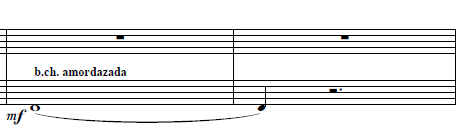
the oboist and the pianist are asked to sing in four different ways: with an "n", with an "o" singing harmonics, bocca chiusa, and bocca chiusa “amordazada” (gagged). in a strictly musical sense, these indications produce different resonances that are related to overtones and timbre.
during the rehearsals, we explored how to perform these ways of singing to differentiate them from one another. we will listen to two different attempts to sing "n" and bocca chiusa:

graciela paraskevaídis - dos piezas para oboe y piano i
in this first attempt, the difference between "n" and bocca chiusa was not clear enough, and they sounded very similar. in a second attempt, the oboist (in charge of the "n" sound in this passage) tried to produce a more "nasal" effect. this highlights higher overtones, creating a difference in timbre, as the second example shows
as for the "bocca chiusa amordazada", we tried to imitate the effect a gag would have while singing by covering our mouths tightly with our hands, as can be heard in the following example:
the composer suggests that the indication "o" means "to unfold vocal harmonics over the indicated pitch, freely exploring the positions and breathing." (paraskevaídis, score). first, we will listen to an excerpt from a rehearsal on november 12th, 2025
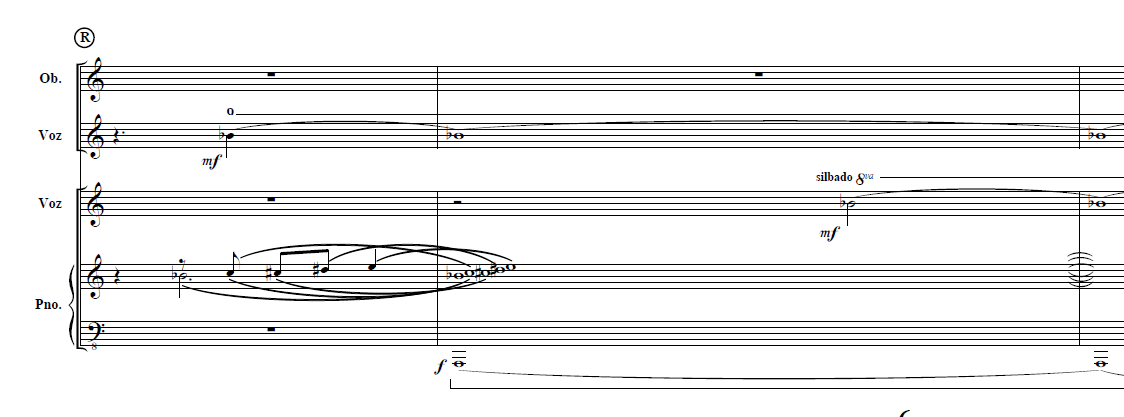
this first example sounds like a regular sung "o". on january 16th, 2026, we worked on that particular indication by the composer. this fragment shows the oboe player experimenting with more vowels and a nasal voice to highlight the overtones:
finally, when we put everything together, this was the result: a very different way of finishing the piece by enriching the timbre.
the use of the voice is not empty of meaning
after analysing some musical elements, we can now revisit the questions stated at the beginning through a careful reflection on the experience of rehearsing and playing this piece.
in the first place, singing while playing compromises our bodies in a way we are not used to. in the particular case of the piano, for example, the breath required to sing and whistle is very difficult to sustain without affecting the stability of the sound. once again, this is something a pianist is usually not trained to do. similarly, by using our voice, there is nothing between us and the audience—or, in a sense, the "other". there is no instrument to protect us; nothing works as an intermediary.
the awkwardness that arises from taking the performer outside of their "expertise" creates a musical tension that compels listening. it is also a sign of something of extreme importance in paraskevaídis's aesthetic: the anti-virtuosity. the performers are deliberately forced to do something in which they are not “virtuosic”. in the same direction, we find INSTRUMENTAL parts that are not “difficult” in a traditional way —meaning many notes, “BEAUTIFUL” sound, no mistakes, ETC.
having placed the musicians in a non-virtuosic setting, forcing an unease in the performance through the use of the voice, there are other symbolic elements we can outline. we will focus on one of them: the indication "bocca chiusa amordazada" (gagged).
the last dictatorship in argentina was the most violent in the country’s history. one of its most terrifying characteristics was the kidnapping and forced disappearance of people based on their political ideology. this violation of human rights was systematically implemented by military and paramilitary forces. one of the elements used during torture and kidnappings was the gag. the goal was, of course, to prevent the kidnapped person from speaking or shouting—that is, to leave them voiceless. being aware of this dark chapter in argentine history, when reading the indication "bocca chiusa amordazada", it is almost inevitable to think of those voiceless people.
perhaps, using the voice in this piece is also a way to remember that even though we do not know how to sing, we can still do it freely.
