lecture read at the colloque musique et identites locales - clermont-ferrand - may 2026
Introduction
Graciela Paraskevaídis was born in Buenos Aires in 1940. After studying piano at the National Conservatory of Music, she continued her studies at the Latin American Center for Advanced Musical Studies and at the Hochschule für Musik in Freiburg im Breisgau. Thanks to the dialogue with other Latin American composers in the 60s, and because of the social and political landscape of that decade, Paraskevaídis took an aesthetic path that places Latin America at the center. This is achieved through the production of counter-hegemonic models with territorial anchoring, which implies a shift in the creative locus of enunciation. Her music presents elements that can be related to an identity-based reclaim of indigenous Latin American cultures. Those elements are not taken in a superficial way but rather as a respectful testimonial tribute to cultures whose local histories have been silenced. In this lecture, we will explore some characteristics of the indigenous worldview (cosmovisión) of the altiplano, some elements of the music of Paraskevaídis, and we will build bridges between them to discover in which way tribute is paid to these cultures from a contemporary language and aesthetic.
The indigenous worldview of the altiplano
In indigenous communities in general and in the Aymara in particular, the relationship with the cosmos, nature and peers, in other words, community, is of vital importance. According to van den Berg,
The cosmos and all it contains is, first and foremost, a harmonious whole, in which everything and everyone has their place and their limits, and in which all parts complement and support one another. This harmonious whole is expressed by the Aymara precisely through their notion of community: a community that encompasses the entire cosmos, embraces it, encloses it and cares for it. (van den Berg, 2018: p. 49).
This means that the members of the communities, the land they work and nature in general enter into a game of relations, opposition, and complementarity of great depth. Consequently, no one is disconnected from their environment and the individual cannot modify it. As Prudencio states,
The troop is like the ayllu, a participatory organisation to which everyone contributes and from which everyone benefits, based on the principle of the individual in the community, by the community and for the community. (Prudencio, 2018: p. 287).
This has its musical correlation that manifests itself in various ways, let’s take for example the concept of arca-ira. In the panflute bands the participants are divided into two groups. The instruments played by each group have the notes that those of the other don’t. This means that only between arca and ira groups is it possible to have all the sounds needed. As Duarte Loza (2018) says, “music cannot be conceived from individuality.” Arca-ira is a reflection of the importance that community has in these cultures. In a similar way, the music of Graciela Paraskevaídis cannot be conceived from individuality. Let’s see a short video of the sikuris in Argentina.
Torcatty maintains that “indigenous music was and still remains attached to magical, medicinal, propitiatory, or thanksgiving ceremonials”. That is the case of this video. The sikuris band is in an ascent to the hill of the Virgin of Abra de Punta del Corral, an event that takes place during Holy Week in northern Argentina. Said celebration honours the virgin who, by the way, is not a traditional indigenous figure but a consequence of the evangelization of American territories. However, this celebration maintains certain pre-Columbian traditions such as giving offerings to the Pachamama (mother earth) before beginning the ascent. Another example of the ritual function of music and its instruments, is the tradition of not using certain instruments in certain seasons. In the words of Prudencio:
It is the diversity of tone, color, intensity, texture, and articulation that is valued as categories in each of the instrumental formations according to their organic typology and also according to their social, ritual or seasonal function (Prudencio, 2018: p. 284).
The sikus are not used in “the rainy season”, around January, because it is related to the dry season. This implies, finally, that there are moments in which certain instruments cannot sound. A structural silence is dictated by the climate and agricultural cycles.
Elements of the selected Works
We will now focus on some elements of Graciela Paraskevaídis's music that are linked to aspects of the worldview we just described. These elements confirm the composer's position on a non-hegemonic periphery. The relations between the musical elements and the indigenous worldview will be approached from a strictly symbolic perspective.
1.- Reiteration in its ritual function
2.- Silence as a structural element
3.- Economy of materials – Austerity
4.- Construction of the group.
Reiteration in its ritual dimension
In many of her works, Paraskevaídis uses repetition as a structuring element. The reiterative is a characteristic also representative of the magic function of music in Latin America. It is not a reiteration that leads the listener to a passive state of trance but to a ritual function in which the musician actively communicates with the earth, nature, and the cosmos.
Aruaru (2003) – Movement III
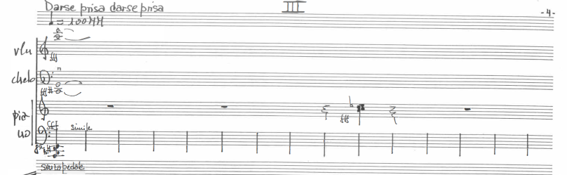
In this first example, the left hand of the piano repeats the same chord composed of two overlapped augmented fourths throughout the movement, a total of 135 times.
Dos piezas para pequeño conjunto (1989) - i. …entre los últimos…
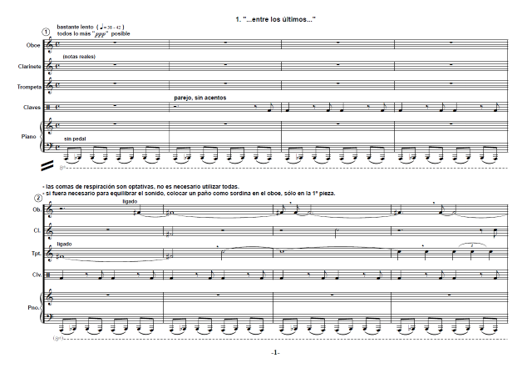
In this example, the piano and claves repeat the same pattern throughout the whole movement.
Sendas (1992) – III – Preferimos infierno en mano a cien volando
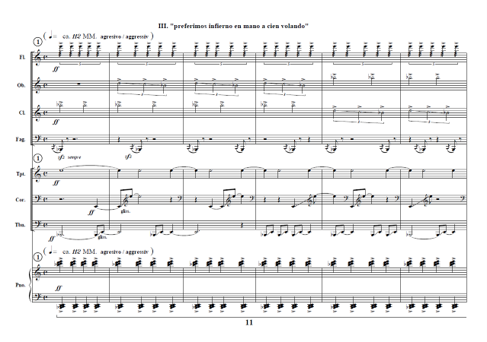
Here each of the eight instruments repeats the same structures with small variations.
This of the reiterative is not void of meaning; it is a recovery of the primitive and magical function of music that differentiate itself from the individualism, representationism, and academicism of western art. To illustrate this link, we can think about the ascent to the hill of the virgin. Paraskevaídis uses the available technical means — like a “contemporary” language, various sound structures that originate from the sound itself—revalues a historically silenced culture and, in turn, resignifies the place that concert music of our time occupies. This means that her music departs from a locus of enunciation different from the traditional and by this, she allows a new circulation of the symbolic elements of these cultures. The composer positions herself in the South, creates from there and spreads, into new circles, a devouring of the elements that traditionally constitute concert music.
Silence as a structural element/Structuring by independent blocks
Paraskevaídis uses silence not as a mere absence of sound but rather as an element that provides expressivity. In the words of Aharonián, for the contemporary composer “music is not a moving sound mass that breathes from time to time, but a large space where volumes exist not only by themselves but also because of the space around them, where silence ceases to be a negation to become an affirmation”.
Aruaru – Movement I
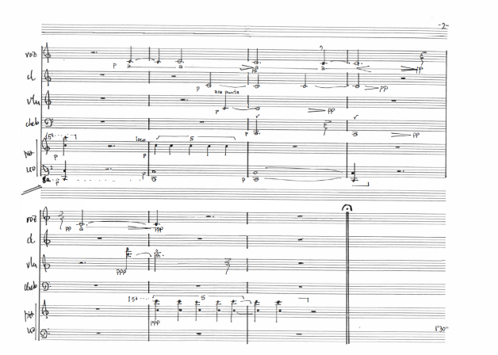
Here, the different sound units are separated by silences. These silences are not breaths but expressive spaces around the blocks.
Sendas I
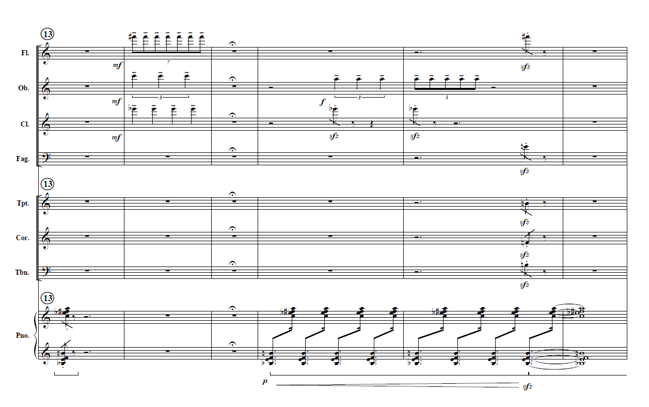
In this example, we can see silence dividing different segments. By becoming an expressive element, silence contributes to generating a non-discursive music in which there is no linear development, but rather a cyclical musical phenomenon. Returning to the aspects of the indigenous worldview, every element of Aymara culture is conceived as cycles: seasons in which the instruments remain silent, seasons to celebrate, to fear, to rest.
Economy of materials and austerity
Rodolfo Kusch maintains that
the Quechua culture was profoundly static. (…) It was a statism that encompassed all aspects of the Quechua culture (...) which revolved around being-there (estar) in the sense of being here, clinging to the cultivated plot, to the community, and to the hostile forces of nature. (Kusch, 1999)
Those hostile forces of nature, from one moment to another could leave the entire community without sustenance. Faced with this magical fear of the forces of nature, a need for austerity arises in which only what is essential is used.
The composer expresses this voluntary austerity by using contemporary musical elements. This economy of materials and the use made of them leads to a very pronounced musical stasis, reinforced by the idea of non-discursiveness that we find in almost all of her works.
Aruaru – Movement I
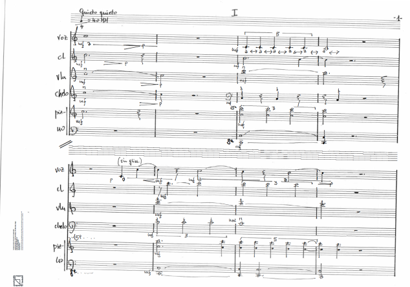
Here we have a movement composed exclusively of a single note (C) in different registers.
Dos piezas para pequeño conjunto – II
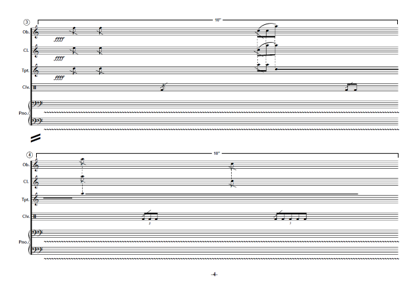
Here, the wind instruments and the claves make short interventions while the piano is constantly playing a trill. The material is reduced to a minimum. The stasis and austerity don’t refer to a passive being-there. This being-there can also be aggressive and visceral.
Sendas
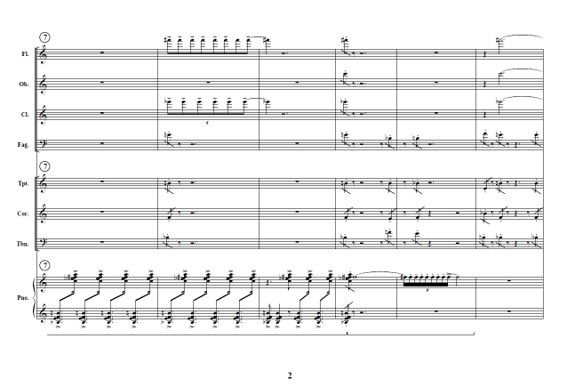
Here, the melodic/harmonic aspect maintains an extreme limitation in the use of materials. It is a single chord of four superimposed augmented fourths.
Construction of the group
The work Sendas was commissioned and premiered by the Ensamble Aventure (Freiburg) within the framework of an anti-commemoration of the fifth centenary of the conquest of America. This is an important aspect to emphasize about the reach and circulation of the composer’s statements.
In the program notes she explains that
each individual instrumentalist not only lacks the chance of highlighting, but he also suffers all the time from a certain syndrome of anonymity (nobody exists without the others), but he must be there so that everything sounds “properly” (Paraskevaídis, 1992: p. 1)
This fact that no one exists without the other, but at the same time they are necessary for it to sound properly, evokes the idea of arca-ira. This way of constructing the group in her chamber music is closely related to the worldview of indigenous peoples in which the individual only exists in community. In the experience of the performance of Sendas in the Conservatoire royal de Liège, all the musicians involved agreed that their individual parts were “simple” but that it turned out to be difficult to play together. We could experience that each one in the ensemble—or the community—was crucial to perform the piece.
Sendas
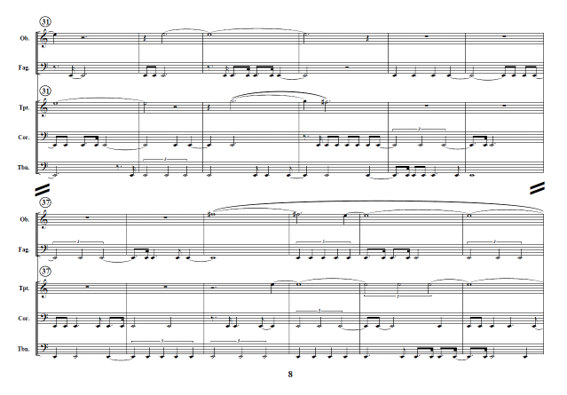
In the second movement, the pedal on E has a significant rhythmic complexity, each part is simple but the timbral and rhythmic texture generated in the ensemble needs each part to function. This could be clearly seen during the work carried out in the rehearsals.
Dos piezas para pequeño conjunto – II
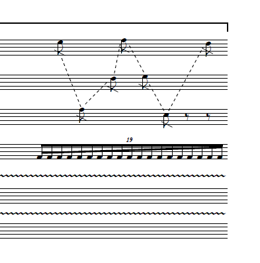
This excerpt shows the relationship between oboe, clarinet and trumpet. Even though it’s not precisely an arca-ira technique, the complete melody is divided among the players. Missing one of them would be missing all.
Conclusion
Graciela Paraskevaídis's music is an example of a paradigm shift of Latin American musical creation that has its origin in the 1960s. Through her music, she questions the established assumptions regarding cultural and territorial identity and history. In the words of Mignolo: “the idea of “America” and subsequently of “Latin” and “Anglo” America was an issue in the minds of European and Creoles of European descent. Indians and Creoles of African descent (men and women) were left out of the conversation” (Mignolo, 2005: 3).
The composer to seeks in her musical creation modes of paying respectful tribute to those communities that were left out of the conversation. Local histories were buried by a single history written in Latin (Mignolo, 2005). Graciela Paraskevaídis's music, as testimonial music, is also a way of recovering those histories, in a respectful and symbolic way using a language that did not originally belong to these communities but that allows new ways of circulating.
In the cultures of the altiplano, identity is collective; the individual only makes sense in their environment. This is what happens in Paraskevaídis's chamber music. Likewise, this collective identity is strongly rooted in the others and in the relationships that arise from them. Without the other, there is no one. We were able to observe a symbolic reproduction, through a different language, of this communitarian vision of the world. Mignolo also states that
Spanish missionaries could not have said “our” or “my” when they were writing the history of the Mexica people, as they could with the memories and subjectivity of their own past. (Mignolo, 2005: 41)
Given the aspects explored in this lecture, we can affirm that Paraskevaídis also attempts to reclaim “our” history, positioning herself in the south. As closing, a quote from the composer that synthesizes her, which is clearly reflected in her music.
To be a composer born under the imposed and strong influence and heritage of “white,” Christian, and bourgeois Western European culture, and to live voluntarily in a third world country, implies assuming the dangers and challenges of such a choice, a choice that seeks to confront the cultural and musical models established by a dominant and Eurocentric first world. (Paraskevaídis 1996)
